
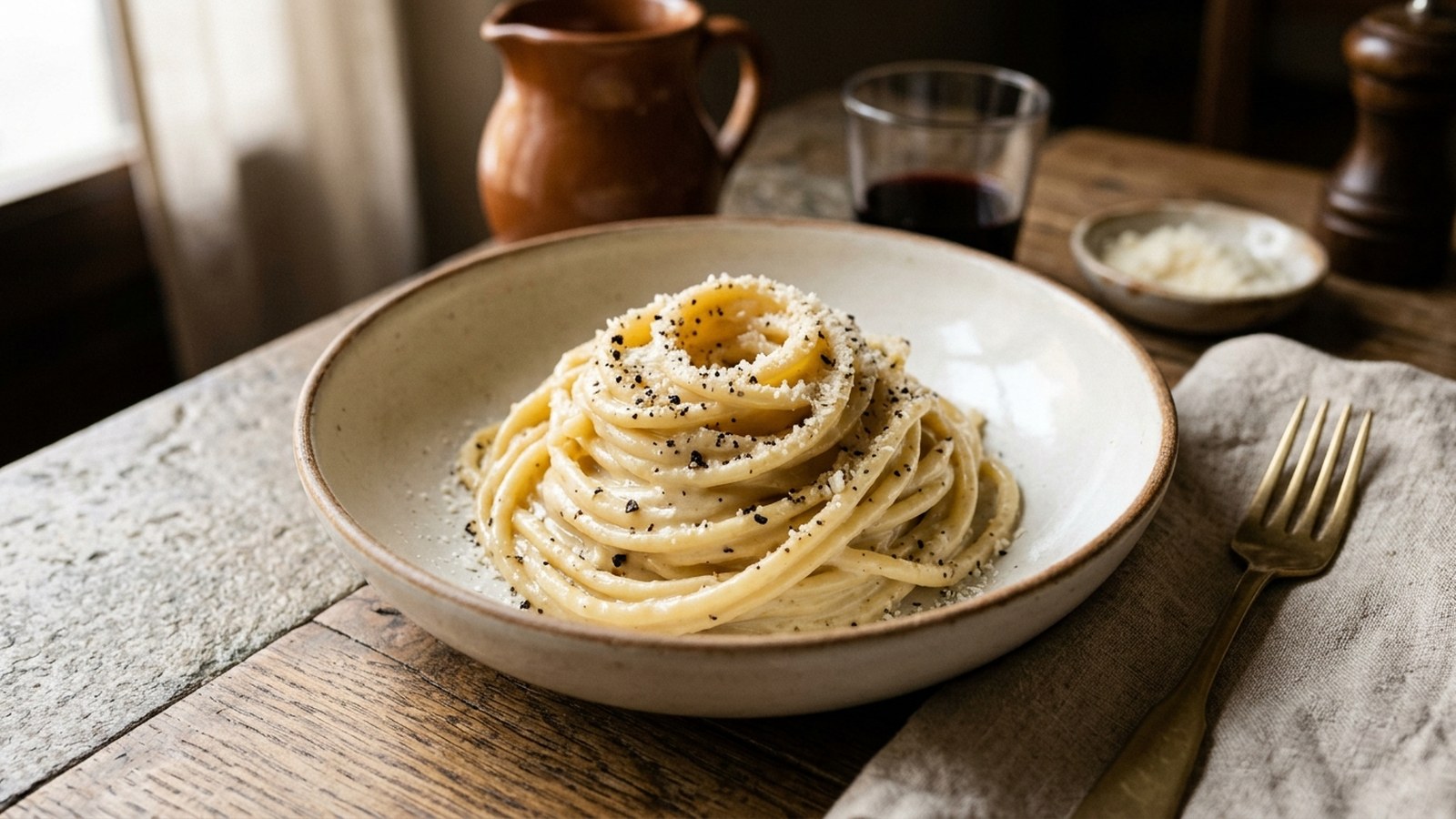
Born among Apennine shepherds carrying cured sheep cheese, dried pasta, and whole peppercorns, Cacio e Pepe is modern culinary science’s sharpest test of temperature control.
Roman Cacio e Pepe (Starch-Gel Cheese Emulsion Science)
Authentic Roman Cacio e Pepe in both 20-minute artisanal mantecatura and foolproof 10-minute cornstarch-water Speed-Hack guaranteeing silk without clumping.

Bistro Executive Chef • "Behind the Line" Column
“Chef Marek’s rule: Pecorino proteins seize above 65 °C. Pull the pan off the flame for 45 seconds before tossing, or stabilize with our 1% starch-gel slurry.”
Step-by-Step Execution & Timers
Boil pasta & thicken 60-second starch gel
Drop pasta in boiling water. In the skillet, whisk 4 g starch with 120 ml cold water and heat 60 s until clear gel forms; fold in cracked pepper.
Starch polymer networks physically block casein proteins from latching together.
Strictly cap starch at 4 g per 220 g pasta to keep silk lightness.
Cloudy slurry turns crystal-translucent.
Whisk Pecorino into warm gel — clump-proof
Off-heat, toss drained pasta and microplaned Pecorino directly into the warm starch gel for 30 s.
Hydrocolloid starch network stays smooth up to 75 °C without weeping grease.
Use coarse freshly cracked pepper rather than pre-ground dust.
Mirror-gloss pasta ribbons cleanly emulsified.
Context-Aware Kitchen Mentor
Snap or simulate a pan frame — Sous-Chef gauges Maillard browning vs. scorching risk.
Starch polymer networks physically block casein proteins from latching together. Burn guard: Strictly cap starch at 4 g per 220 g pasta to keep silk lightness.
Tell me what you see and hear right now on "Boil pasta & thicken 60-second starch gel". Look for this exact cue: Cloudy slurry turns crystal-translucent.
Kitchen FAQ (Schema Grounded)
Does traditional Roman Cacio e Pepe ever contain butter or cream?
Never in classic Rome. Pure starchy pasta cooking water emulsifies the melted sheep-cheese fats at 56–62 °C.